




KAPAWI LODGE RAINFOREST
TOURS
No roads, logging or oil
exploitation
Access only by air
5 000 Km2
4.500 Achuars
60 Indigenous communities
Over 540 bird species
LODGING
The
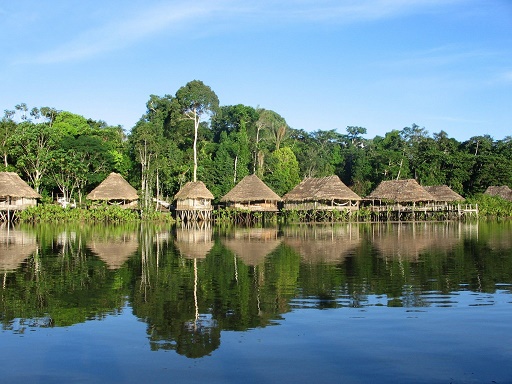
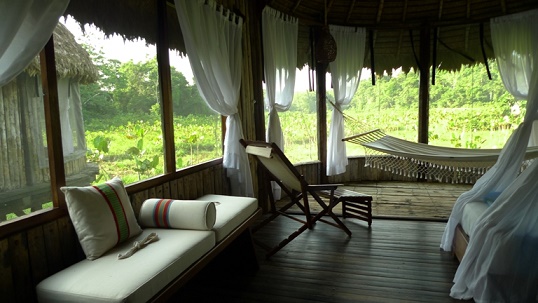
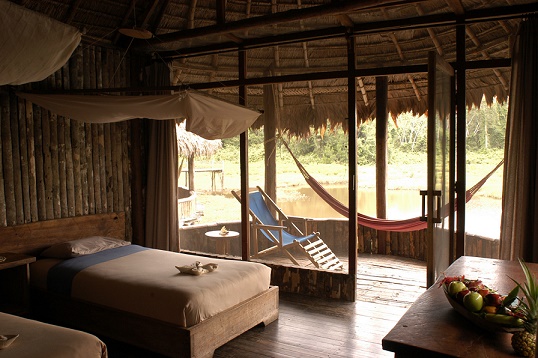
lodge accommodates up to 50 visitors with
double and triple accommodations and was built
in accordance to the Achuar concept of architecture.
Kapawi is the largest community-based project
ever developed in Ecuador. It was developed
and built in co-ownership with the private
enterprise, Canodros S.A.. Kapawi was created
to provide a high standard service in one
of the remotest and most pristine areas of
the south east of Ecuador, away from oil exploitation
and other destructive practices.
At the moment up to 70% percent of all the
employees that work at the lodge are Achuar.
Canodros also buys products and services for
the lodge in the nearby communities. Tourists
give a contribution of US $10 dollars as an
entrance fee. For these communities their
main income comes from ecotourism.
Kapawi has also provided a launching platform
for the Achuar as it has brought the area
to the attention of many people from non governmental
organizations that invested money and time
to develop projects to reinforce the structure
of the FINAE organization and developing different
projects parallel to ecotourism such as: health,
communications, transportation,and education
for the entire Achuar territory.
RAINFOREST PLANTS
A tropical rain forest is characterized by its lack of grasses and sedges between the trees, the dense forest, the forest floor, with the reduction of shrub-like plants, herbaceus plants and vines because of the lack of light. A mild irony of nature in the tropics is that, though there are more tree species than anywhere else many are sufficiently similar so that one can meaningfully describe as a “typical tropical tree.” Leaves of tropical plants are characteristically oval and unlobed and they often possess sharply pointed ends, called drip tips, which help to facilitate the runoff of rainwater
Red, orange and yellow flowers are associated with bird-pollinated plants (particularly by hummingbirds), while blue and lavender flowers are commonly bee-pollinated. Some trees produce conspicuous fragrant white flowers that attract bats or moths at night. Small white and yellow flowers are mostly pollinated by bees, beetles, flies and butterflies. Of course, while various insects are more attracted to particular colors and odors, any flower could be visited by any insect if it has nectar.
RAINFOREST BIRDS
During the past seven years, 530 species have been recorded in the Kapawi area. This number includes the seasonal migrants from Patagonia or North America. Though everyone wants to see toucans, macaws and parrots, these and many others birds cannot be seen until they fly out across a river or other forest gap or gather in the mornings at our parrot saltlick. However, many hawks, kingfishers, orioles, flycatchers and anis can be easily spotted or you can walk in the forest to look for shy and inconspicuous antbirds, tinamous, manakins, and puffbirds. And once in a while even a harpy eagle or fiery topaz hummingbird may present itself as a rare surprise!
BIRDWATCHING
Kapawi is a great place for
birding. In ten days you can get a list of
almost 400 species. The river islands often
have Horned Screamers and Orinoco Geese. Muscovy
Ducks are more prevalent here than at any
other place and they are even in the Kapawi
Lagoon. Pavonine Quetzals nest on the Kapawi-Montalvo
trail as is the Rofous Potoo, and there are
also Black-necked Red Cotingas, Pearly Antshrikes
and Pheasant Cuckoos. Brown Jacamars are more
numerous in Kapawi than at any other place
you have been; ditto for Ecuadorian Cacique
and Olive Oronpedola. There are many Blue-throated
Piping Guans, Herons and Egrets. A Black Bushbird
often hangs out near the cabañas and
Red Fan Parrots are on the Capahuari river.
You can see and hear Plumbeous Antbird, Dusky-throated
Antbird, Dot-backed Antbird or Buff-breasted
Wren.
Other bird of exceptional interest featured
in Kapawi are Salvin´s Currasow, Buckley´s
Forest-falcon, Sapphire Quail-dove, Blue-winged
Parrotlet, Scarlet-shouldered Parrotlet, Black-billed
Cuckoo, White-chested Puffbird, Spotted Puffbird,
Tawny-throated Leaftosser, Amazonian Umbrellabird,
Orange-eyed Flycatcher, Moriche Oriole and
the most amazing thing is that you yourself
can see and record new species on the islands!
KAPAWI LODGE